Bernell Vision Therapy Basement Games
Bernell Vision Therapy Basement Games
Low stock: 1 left
SKU:BER-BCBANFSF
Couldn't load pickup availability
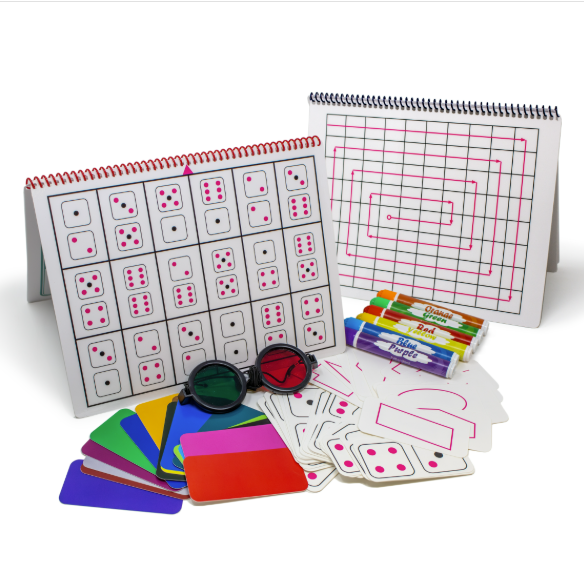
Created by developmental optometrist Dr. Virginia Donati, the Bernell VT Basement Games combines two dynamic visual therapy activities—Near/Far Seek & Find and Rhythm Dotting MFBF—into one comprehensive training toolkit. Designed to support the development of visual attention, spatial centering, bilateral coordination, rhythmic timing, and Z-axis target identification, this set offers flexible applications for monocular, binocular, or Monocular Fixation in a Binocular Field (MFBF) therapy formats.
What's Included:
- Laminated 8.5" x 11" Near/Far Seek & Find Activity Book
- 54 Durable Vinyl Flash Cards for Seek & Find Game
- 6 Paint Dot Markers
- 1 Pair of Elastic Deluxe Red/Green Glasses
- Laminated 8.5" x 11" Rhythm Dotting MFBF Activity Charts (included 4 charts with multiple orientations)
- Step-by-step instruction guides for both activities
Near/Far Seek & Find Training Game
How It Works:
- Patient is seated at Harmon Distance with the laminated chart placed in front of them.
- Therapist stands at a distance holding a shuffled stack of visual flash cards.
- Therapist presents one card at a time; patient visually scans the near chart to find and mark the matching image using a dot marker.
- After each round, rotate the chart orientation to prevent memorization and ensure fresh visual search patterns.
Training Variations:
- Use monocularly (with one eye patched), binocularly, or with red/green glasses for MFBF training.
- Switch dotting hands between rounds to encourage bilateral integration.
- Introduce a metronome to add rhythmic timing and auditory processing demands.
- Progress difficulty by advancing from Color to Shape to Dice charts.
Therapeutic Goals:
- Enhance visual attention and figure-ground discrimination.
- Improve centering, localization, and Z-axis spatial awareness.
- Support near/far visual processing and search accuracy.
- Develop direction of action and visual-motor planning.
Rhythm Dotting MFBF Activity
How It Works:
- Patient stands or sits at a comfortable surface height and uses dot markers to complete progressive dotting patterns on laminated charts.
- Begins with Chart 1 to learn dotting technique, then progresses through single-handed, opposite-handed, and alternating-handed tasks.
- Incorporate red/green glasses for MFBF training and visual suppression awareness on Charts 2-4 (featuring skipped boxes, spirals, and mazes).
- A metronome (set to 120 bpm) is used to develop and reinforce rhythm and timing consistency.
Training Variations:
- Perform tasks monocularly, binocularly, or with MFBF setup using red/green filters.
- Alternate dotting hands to build bilateral control and symmetry.
- Use different marker colors in each hand to visually reinforce laterality and alternation.
- Vary chart orientations to challenge spatial memory and prevent anticipation.
Therapeutic Goals:
- Develop hand-eye coordination and motor rhythm synchronization.
- Promote spatial centering and positional awareness through structured movement.
- Reinforce MFBF awareness and interocular balance.
- Enhance motor planning, sequencing, and timing in visual tasks.
Share